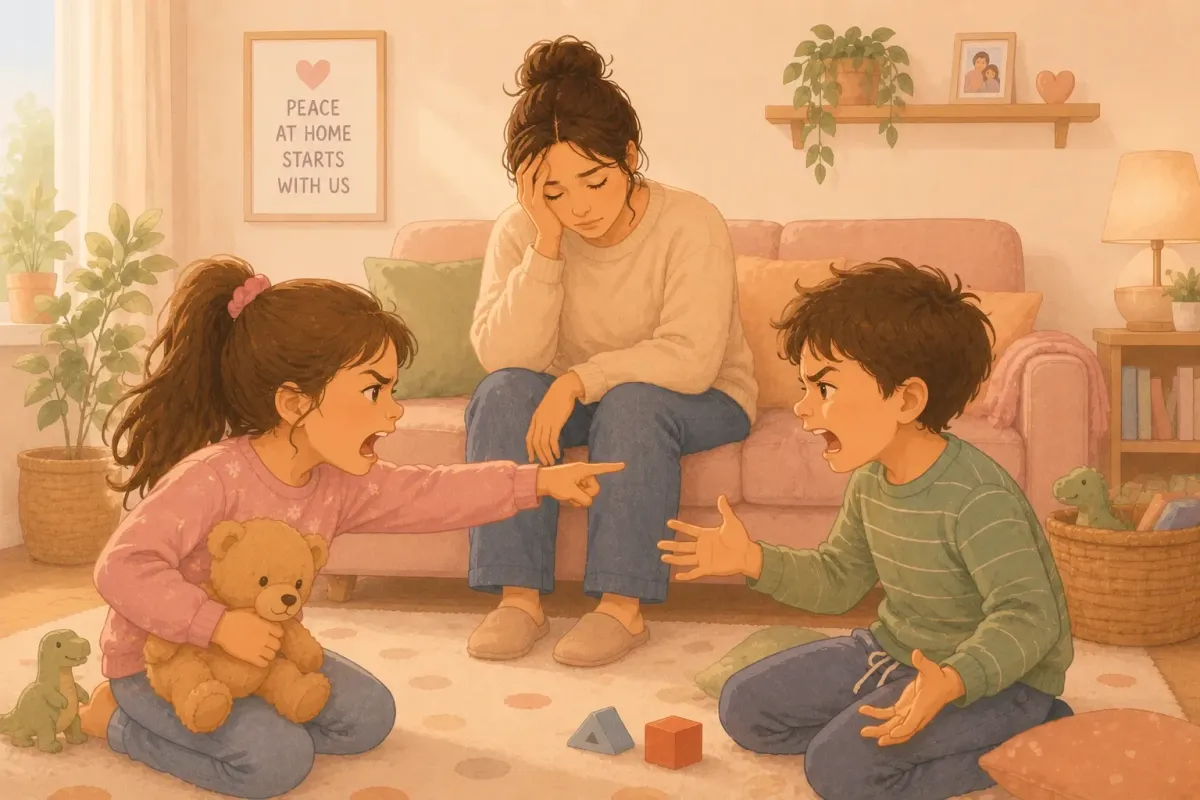
My Children Fight All the Time - How Do I Stop the Sibling War?
It starts before breakfast. It continues in the car. It escalates the moment they're both in the same room with nothing to do. And by 4pm on a bank holiday weekend, you have refereed seventeen arguments, raised your voice twice, and seriously considered whether it would be morally acceptable to put them in separate houses.
Sibling fighting is one of the most relentless, energy-draining experiences of family life. Not because the arguments are serious - most of them aren't - but because of the sheer volume, the predictability, and the helplessness you feel when nothing you do seems to make the slightest difference.
If your home feels like a war zone, this article is for you. I want to explain what sibling conflict is actually about (it's rarely about what they say it's about), what makes it worse (including some very common parenting responses), and what genuinely helps - not just in the moment, but in building a home where siblings actually want to be around each other.
Why siblings fight - the real reasons underneath

Before we talk about what to do, it helps to understand what's actually driving the conflict. Because most sibling arguments are not really about who had the remote control first, or whose turn it is, or whether one of them looked at the other one "in a weird way."
Those are the presenting issues. Underneath them, sibling conflict is almost always about one or more of these things.
Competition for parental attention and love. This is the most fundamental driver of sibling rivalry, and it runs deep. From an evolutionary standpoint, siblings are genuinely competing for a finite resource - the care and attention of their primary caregivers. Even in the most loving, attentive families, children register every moment where a sibling seems to be getting more: more praise, more time, more patience, more flexibility. The argument about the TV remote is often a proxy for "am I valued as much as they are?"
The need for power and control. Children have very little control over their lives. They can't choose when they sleep, what they eat, where they go, or what the rules are. Conflict with a sibling is one of the few arenas where a child can exercise power - winding someone up, provoking a reaction, getting a sibling in trouble. If a child is feeling particularly powerless elsewhere (at school, in their peer group, in response to a family change), sibling conflict often intensifies.
Poor emotional regulation, not bad character. When children are tired, hungry, overstimulated, or stressed, their capacity to tolerate frustration plummets. The sibling who is normally manageable becomes unbearable. The small irritation that would ordinarily be ignored becomes a catastrophe. Most sibling fights happen in the late afternoon for a reason - it is the point in the day when children's regulatory resources are most depleted.
Genuine temperament clashes. Some siblings are simply very different people who find each other genuinely difficult. One is loud and energetic, the other is quiet and sensitive. One needs to talk through everything, the other needs silence to decompress. These differences don't disappear - but they can be understood, named, and worked with rather than simply colliding.
A third factor you're not seeing. Often the argument in front of you is not the beginning of the story. One child did something to the other an hour ago that you didn't witness. There is existing tension from yesterday, or last week, or a pattern of one child repeatedly undermining the other in ways that are subtle enough to escape parental notice but significant enough to generate real resentment. What you see is the eruption. You rarely see the build-up.
What sibling conflict looks like at different ages
Sibling conflict is not one thing. It looks very different depending on the ages involved - and the response that works for a four-year-old and an eight-year-old is not the same one that works for an eight-year-old and a twelve-year-old.
One particularly important pattern to notice: children who appear completely unbothered. Some children - especially those who are naturally more inward, or who have learned that expressing worry is not safe - will show very little outward anxiety and then hit a wall in September. A child who says "I don't care, it'll be fine" repeatedly and shuts down any conversation about it may need just as much support as one who is openly tearful.
What makes it worse - the well-meaning responses that backfire
Jumping in immediately to fix it. The instinct when children fight is to intervene quickly and make it stop. But immediate adult intervention robs children of the opportunity to work things out themselves - which is a skill they genuinely need to develop. It also often escalates the situation, because now there is a powerful adult audience and a verdict to be won. For minor squabbles where no one is in danger, wait. Give them a chance to resolve it first.
Taking sides. "She started it" and "he always does this" are the two things children most want you to validate. Resist. The moment you take a side, you have lost the other child - and you have almost certainly missed half the story. Even when one child's behaviour is clearly worse in this particular moment, the dynamic between them is never that simple. Siding consistently with one child over time creates a persecutor/victim dynamic that hardens rather than resolves.
Punishing both equally for everything. The inverse mistake - treating everything as equally both their fault - also backfires. Children have a finely calibrated sense of fairness. When the child who was genuinely wronged receives the same consequence as the child who wronged them, they learn that adults can't be trusted to see the truth. Acknowledge what you saw accurately, even when you don't have all the information.
Comparing them to each other. "Your sister never behaves like this" or "why can't you be more like your brother?" are two of the most reliably damaging things you can say to a child - and two of the most effective ways to intensify sibling rivalry. Comparison communicates that your child is being measured against their sibling and found wanting. It adds shame to an already charged situation and deepens the resentment between them.
Expecting older children to simply "know better." Holding an older child to a higher standard is reasonable. Expecting them to always be the one who backs down, always be the one who is patient, always be the one who absorbs the younger child's behaviour without reacting - is not. Older children resent this deeply, and rightly so. They are children too.
Shouting "stop it" from another room. This communicates parental presence but has no actual effect on the behaviour. Children learn quickly whether a parental intervention is real or not. If you're going to intervene, be present - get in the room, get low, make actual contact with what's happening.
What actually helps - in the moment and over time
In the moment: regulate before you resolve. When two children are in active conflict, their nervous systems are dysregulated. You cannot reason with a dysregulated child - the thinking brain is offline. Before any conversation about what happened, who did what, and what should happen next, you need to help them regulate. This might mean separating them briefly - not as a punishment, but as a reset. It might mean sitting with each one quietly before bringing them together. It might mean your own regulated, calm presence as the thing that helps their nervous systems settle.
Name the feeling, not the behaviour. Instead of "stop shouting at your sister," try "you are really frustrated right now." Instead of "that was unkind," try "it looks like you're feeling left out." Naming the feeling underneath the behaviour doesn't excuse the behaviour - but it addresses the actual cause rather than the symptom. Children who feel understood are significantly more able to then engage with expectations around behaviour.
Hold individual time as non-negotiable. One of the most consistent findings in sibling rivalry research is that children who receive regular, protected one-to-one time with a parent fight significantly less with their siblings. Not because they're getting more in total, but because the competition anxiety - am I loved enough, do I matter - is being answered directly. Even twenty minutes of genuine one-to-one attention, where the other sibling is not present and the phone is not out, makes a measurable difference.
Teach the skills they're missing. Sibling conflict is often a sign that children haven't yet developed the skills they need: how to negotiate, how to express frustration without aggression, how to repair after a conflict, how to ask for space. These skills can be taught - not in the middle of an argument, but in calm moments. Role-play scenarios. Talk through what happened after the dust has settled. Name what good conflict resolution actually looks like, so they have a model for it.
Create structures that reduce the flashpoints. Many sibling fights happen in predictable situations: the same time of day, the same triggers, the same competition over the same resources. If the 5pm screen time transition always ends in a fight, that transition needs a structure. If the back seat of the car is reliably explosive, change the seating arrangement. You are not going to eliminate conflict through rules - but you can reduce the volume by anticipating the conditions that produce it.
Narrate the relationship positively. Children internalise the stories they are told about themselves and their relationships. If the dominant story in your household is "you two never get along," that becomes a self-fulfilling identity. Actively look for and narrate moments of cooperation, kindness, and connection: "you helped her with that without being asked - that's the kind of big brother I know you are." The story you tell about the relationship shapes the relationship.
When sibling conflict crosses a line

Most sibling conflict is normal, expected, and developmentally appropriate - even when it feels unbearable. But there are situations where it crosses into something that needs more serious attention.
Consider speaking to a professional if one child is consistently targeting the other in ways that are humiliating, controlling, or designed to cause distress rather than just win an argument. If one child is physically hurting the other repeatedly, with intent rather than in the heat of conflict. If the dynamic has solidified into a clear aggressor and victim, where one child is visibly fearful of the other. Or if one child is significantly withdrawing, seems unhappy most of the time, or is showing signs of anxiety or low mood that appear connected to the sibling relationship.
These patterns are not normal sibling rivalry. They are a family dynamic that needs support - and they are very amenable to change with the right help.
You might also find helpful
Why Does My Child Have Meltdowns Over Small Things?
Child Can’t Focus on Homework? What’s Really Going On (And What Actually Helps)
Are Video Games Healthy for Kids? How Much Screen Time Is Too Much?


